By Amy Stuiver
Let me take you into the reality of what it is like to buy something on Temu. I open the app. WOW! YOU HAVE WON 10 FREE ITEMS. Tap the egg three times to claim your reward. Choose your 10 free gifts! By the way, you do need to spend a minimum of 30 euros to actually receive these gifts. Oh, and by the way: if you add another 60 euros to your cart, you get 30% off all items and your next order comes with free shipping.
This is a Temu experience in short. We have all fallen for it at some point. We have all been a Temu victim at least once.
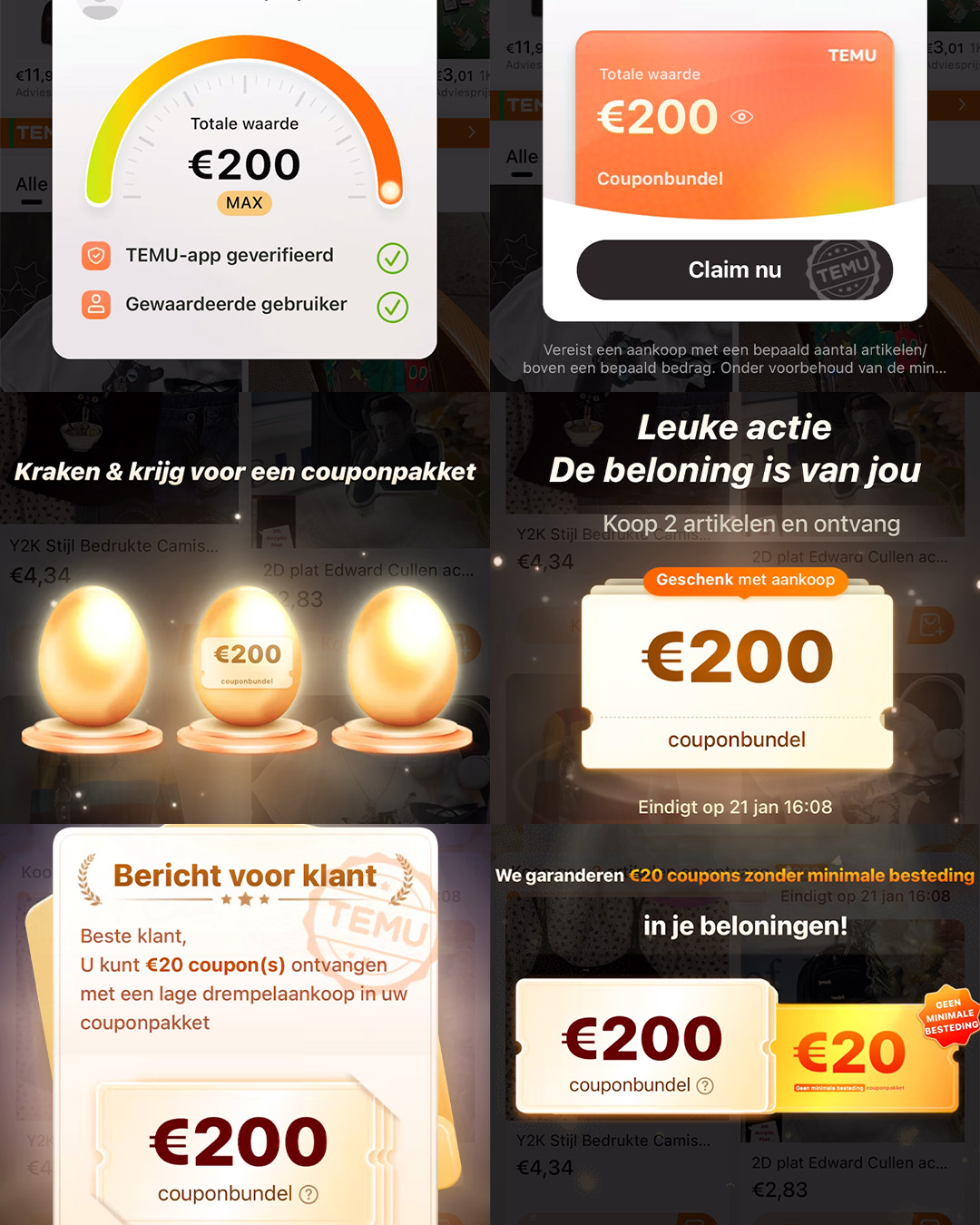 Pop-ups in Temu-app
Especially us Dutch people, who love a bargain, are drawn to deals like this. The moment we see the word “free,” we immediately consider taking it. But why are extremely low prices so attractive to us? When we see an item that costs just 1 euro and we buy it, we instantly feel like we are being smart. Look at how much value I am getting. It literally feels like winning something. Because yes, I just found cat socks for only 1.80, so why not? Even though we do not need it, it still feels logical to buy it.
Temu does everything it can to make the experience as fast and effortless as possible. A purchase on Temu is completed within seconds. The app pushes you to keep scrolling to see more products. It is an endless page that just keeps going and going, filled with countless items. Everything you can think of, you can probably find on Temu. The natural stopping moment disappears, which means you are constantly being tempted again. Buying starts to feel less like spending money, because it becomes something you just do “on the side.” Impulse purchases (Temu Victims) increase.
 Temu add
It is no longer really about the products that eventually arrive at our door. The act of buying itself gives us a strong dopamine boost. It is a pleasant distraction from stress we might be experiencing at that moment. It gives us a sense of control. We choose it, and we get it.
Buying behavior on Temu is not just a personal choice. It is largely designed behavior. Going back to the introduction of this article, constant stimuli are being activated. Bright, cheerful colors in pop-ups offering amazing deals trigger dopamine in our brains. And they know exactly how addictive this can be, using smart timing, triggers and design. You might almost think you lack self-control when you go along with it, but the system is specifically designed to bypass that self-control.
I will admit that I myself have been a Temu victim as well. It remains tempting. That is why it is important to keep reflecting on what is happening while you are shopping there. When you understand how buying behavior is being influenced, space is created to pause for a moment and make a new choice.
Do you see this as a smart marketing strategy, or more as manipulation?
Share the story and tell us your answer!
Do you know inspiring stories or initiatives that show how our society is changing for the better? Send your story to stories@wearenami.com. We would love to put your story in the spotlight!

Hopeless romantic, filmmaker in the making, and a writer drawn to the beauty of tragedy, love, and fiction. Her stories are deeply visual and aim to pull the reader all the way into the emotion. Again and again, she explores one central question: how far would you go for what you desire, fear, or love?
Office
Manitobadreef 7C
3565 CH Utrecht
The Netherlands
Postal Address
Manitobadreef 7C
3565 CH Utrecht
The Netherlands