Imagine two pairs of boots. One costs $50 and lasts a year. The other costs $250 and lasts ten years. The person who can afford the $250 pair spends $25 a year. The person who can only afford the $50 pair is forced to spend $50 every single year. After ten years, the poorer person has spent $500, while the wealthier person spent $250.
This is the Sam Vimes "Boots" theory of socioeconomic unfairness. It is the reality that being poor is incredibly expensive. Yet, our current retail environment completely masks this inequality.
Humans are biologically wired for "hyperbolic discounting." We instinctively value a small reward today (spending less at the checkout) over a much larger saving in the future. Manufacturers exploit this by designing products that are just cheap enough to be tempting, but just fragile enough to require constant replacement.
We call this a free market, but it is a market built on asymmetric information. The manufacturer knows exactly when the machine will break; you, the consumer, are left guessing.
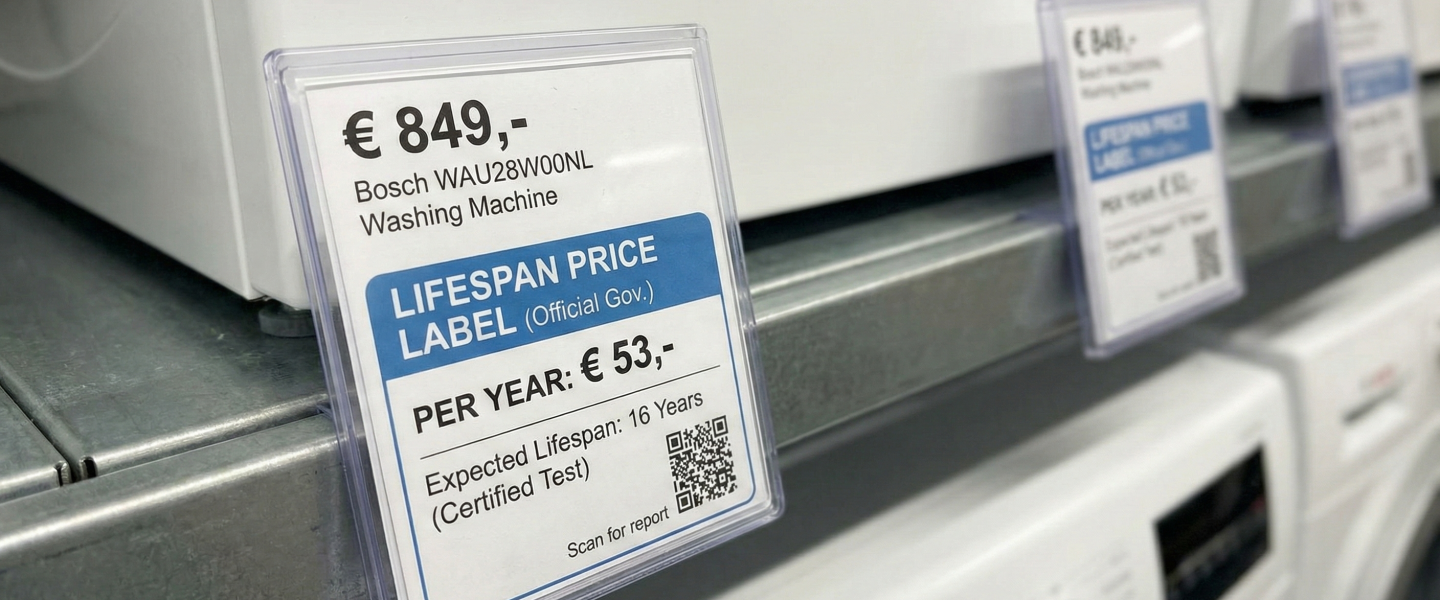
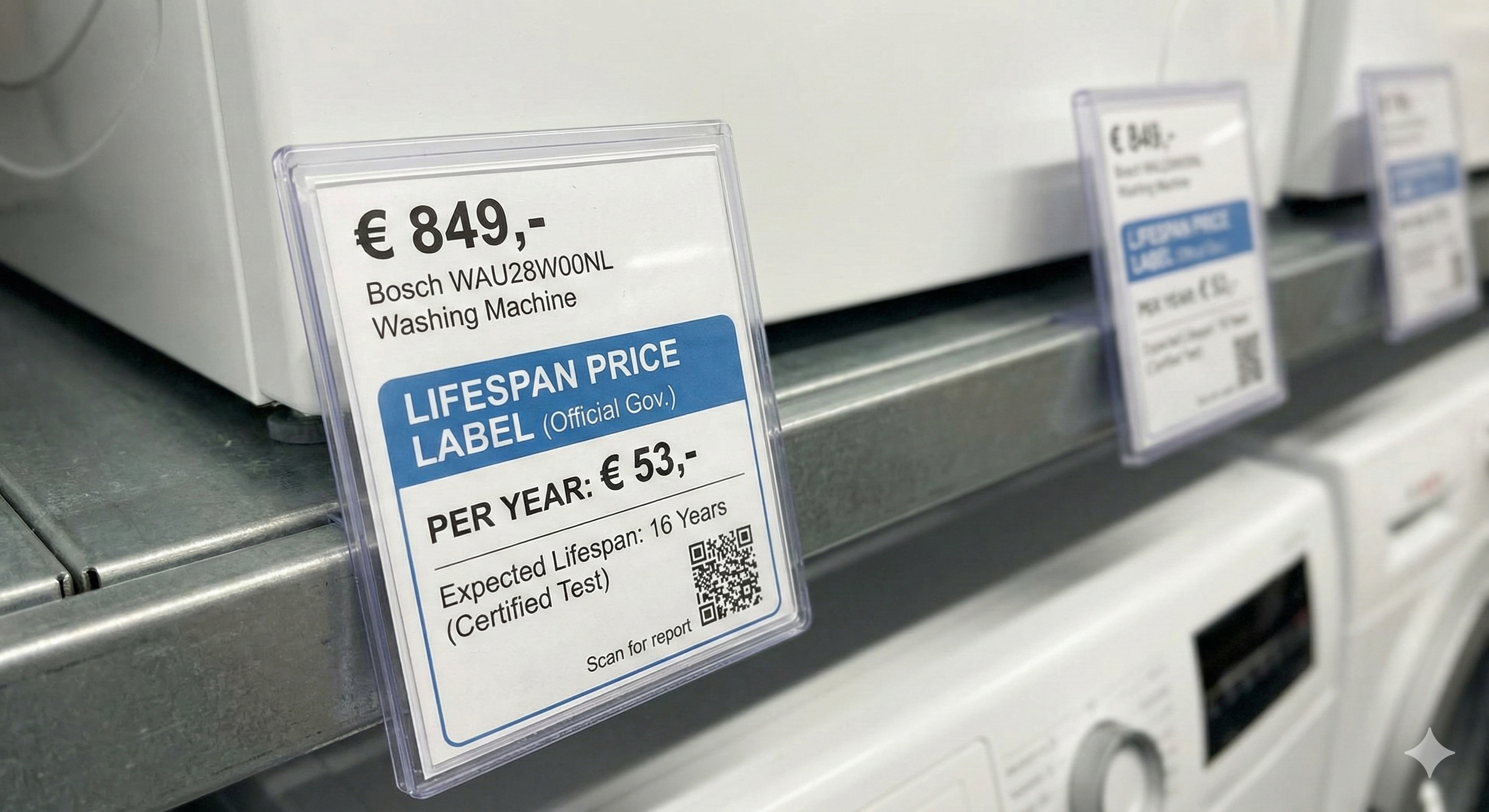
To jumpstart a truly circular economy and break the poverty trap, we must restore the consumer's position of power. The proposal is simple: mandate the display of the price per expected lifespan on every price tag.
This would not be a vague marketing claim from the brand, but a verified metric calculated by an independent, centralized authority.
Honest comparison: A $800 washing machine that lasts 15 years ($53/year) suddenly looks like a much better deal than the $350 "bargain" that hits the landfill in three years ($116/year).
Incentivizing quality: In a system where the "annual price" is the dominant anchor, planned obsolescence becomes a suicidal business strategy.
The circular necessity: Products that are easy to repair receive a longer certified lifespan, resulting in a lower annual price. Repairability finally becomes a competitive advantage.
Transparency alone does not solve everything. For the consumer who literally cannot pay their rent today, an $800 machine remains out of reach, no matter how low the annual price is. This label must be accompanied by new financing models or "product-as-a-service" structures to be truly inclusive.
Furthermore, execution is complex. A centralized body must develop testing protocols that can withstand the legal pressure of billion-dollar corporations. However, complexity is not an excuse for maintaining a broken status quo.
Our current obsession with the purchase price sustains a system that exhausts both the planet and the financially vulnerable. By making the "real price" visible on the shelf, we give consumers the power to choose actual value over temporary cheapness.
It is time for our economy to stop rewarding waste. Let’s start with the price tag.
Check out the post on my LinkedIn, comment what you think and share the story!
Do you know inspiring stories or initiatives that show how our society is changing for the better? Send your story to stories@wearenami.com. We would love to put your story in the spotlight!
Office
Manitobadreef 7C
3565 CH Utrecht
The Netherlands
Postal Address
Manitobadreef 7C
3565 CH Utrecht
The Netherlands